DNA Test for Skin Health

Balding or Wrinkles?
Slow down hair & skin aging from the inside out.

Expensive creams can't fix genetic collagen loss. Your MMP1 gene controls collagen breakdown.

Your DNA controls how collagen is built, how androgens involved in skin and hair health are processed, and how skin renews from the inside out. Find out if you need collagen.

Wrinkles, pigmentation, sensitivity - everyone's skin ages differently

Your skincare routine matters, but your DNA and epigenetics explain why some people show early wrinkles, others tan or spot more easily, and why stress, pollution, and UV leave lasting marks.

EvoDNA skin DNA test reveals your unique skin biology so you can protect, nourish, and renew with precision.

Key Benefits

Epigenetic Skin Markers

Track how lifestyle accelerates or slows skin aging.

Antioxidant Defense

Understand your skin's protection against UV & pollution.

Firmness & Elasticity

See your natural collagen profile.

Skin Inflammation & Healing

Discover scarring, redness, and repair tendencies.

Pigmentation & Sensitivity

Learn how your DNA influences tanning & sun risks.

Backed By Science

Where Yale-grade science meets everyday wellness.

Why It Matters

Collagen methylation explains why skin thins with age.

UV exposure leaves lasting epigenetic marks, even after sunburn fades.

Pollution triggers pigmentation and wrinkles via epigenetic stress pathways.

How is skin DNA testing transformative?

Skincare products are everywhere, but most are generic solutions. Your DNA test results reveal what actually works for you.

This test uncovers how your DNA influences your body’s collagen breakdown, pigmentation, and oxidative stress defences. It enables skincare routines designed around your unique biology, guiding prevention and anti-aging strategies.

Genes plus the right products keep your skin young.

What you will receive

DNA Test for Skin Health | EvoDNA

Who this test is for

The Science Behind DNA Testing For Skin Health

  • Some individuals are genetically predisposed to weaker collagen—leading to early onset of wrinkles, loss of elasticity, and accelerated skin aging.
  • Others carry pigmentation variants that increase freckles and overall UV sensitivity, meaning their skin is more prone to sun damage and uneven tone.
  • Epigenetics—dynamic changes caused by sun, stress, and pollution—can speed up or slow down visible aging by altering how your skin genes activate repair, antioxidant, and regeneration pathways.
  • A professional skin DNA test is the most comprehensive way to reveal the complex interplay of your genetics, environment, and skincare routine for true personalization and prevention.
  • You’ll learn details to explain all important factors contributing to your skin health, including:
  •  
  • Firmness & Elasticity: Find your skin’s natural collagen strength, risk for sagging, and tendency toward wrinkles, by testing genes such as MMP1, COL1A1, and COL5A1—the gold standard in anti-aging genomics.
  •  
  • Antioxidant Power: Assess your SOD2 and GSTM1 gene capacity for detoxification, free radical protection, and resistance to oxidative skin damage; skip the guesswork in finding the right antioxidants for your needs.
  •  
  • Pigmentation & Sun Sensitivity: Advanced MC1R and TYR mapping lets you discover your tanning ability, sunburn risk, tendancy to spot/freckle, and where you fall on the spectrum of photo damage.
  •  
  • Inflammation & Healing: Learn about your skin’s ability to manage redness, scarring, and immune response. This can drastically affect your outcome with products, recovery from breakouts, and even manual treatments.
  •  

Aging & Environmental Factors: Epigenetic markers, unique to the test, reveal changes from cumulative UV, pollution, and diet—giving you a dynamic picture that ties your skincare routine to your lifestyle.

Skin DNA testing is a science-driven way to gather detailed information about your unique skin profile using a sample collected with a simple cheek swab. These tests analyze specific genetic markers to assess your natural protections against free radicals, your tendency toward skin inflammation, and how your skin may respond to aging and environmental stress. 

The skin DNA test uses cutting-edge genetic sequencing to analyze every marker tied to firmness, collagen integrity, pigmentation, antioxidant protection, and overall aging.

  • MC1R variants affect skin tone, tan/freckle propensity, and UV sensitivity.
  • MMP1 and COL1A1 (plus COL5A1) determine the strength and degradation rate of your skin’s collagen matrix—pinpointing your true wrinkle risk and skin elasticity.
  • Antioxidant genes like SOD2 and GPX1 play a vital role in defending against oxidative stress and environmental skin damage (a major cause of spots, roughness, and unevenness).

This is the most advanced, objective way to end “trial and error” in skincare. Your results will connect specific products—SPF, antioxidants, serums—directly to your genes for maximally effective, preventative strategy.

Collagen synthesis and degradation pathway

Potekaev et al., 2021. https://www.mdpi.com/2079-9284/8/4/92


The Key Genes and Pathways 

Gene

SNP

Function

Impact

Relevance to Skin

MMP1

rs1799750

Collagen breakdown

Higher → faster loss

Linked to wrinkles/sagging

COL1A1

rs1800012

Collagen type I production

Impacts elasticity

Affects wrinkle formation

SOD2

rs4880

Antioxidant defense enzyme

Handles UV/oxidative stress

Low = higher UV damage

GSTM1

Deletion

Glutathione detox enzyme

Low detox = more stress

Acne risk/oxidative stress

MC1R

Multiple

Melanin production gene

Freckles/red hair/melanoma

Freckles, melanoma risk

TYR

rs1126809

Tyrosinase, melanin synthesis

Alters tanning, sunspots

Sun response, age spots

Epigenetics explain why identical twins—with the same DNA—can have dramatically different skin by age 50. The effect of sunlight, pollution, stress, and diet cause epigenetic marks on your skin cells that influence resilience, pigmentation, barrier integrity, and the speed of visible aging.

  • Methylation of COL1A1: Silences key collagen genes, accelerating wrinkle formation—explaining why some people respond better to topical collagen stimulators.
  • UV-Induced Histone Modifications: Sun exposure modifies chromatin structure and DNA repair—leading to increased pigmentation and uneven tone.
  • miR-21 & miR-34 (miRNAs): These small molecules regulate cell aging and repair—dysregulation increases the risk of premature skin aging or poor healing.
  • Pollution-driven methylation: Urban living accelerates pigmentation, dullness, and premature aging through stress-induced methylation and microinflammation.
  • Epigenetic drift: With age, random methylation changes appear, causing patchy tone and loss of elasticity—a new frontier in anti-aging dermatology.

Epigenetic Markers 

Epigenetic Marker

Mechanism

Impact on Skin

COL1A1 Methylation

Silences collagen genes

Speeds wrinkle formation

UV-Induced Histone

Chromatin remodel post-sun

Alters DNA repair/pigmentation

miR-21, miR-34

Regulate cell aging/repair

Increase aging if dysregulated

Pollution Methylation

Stress-induced methylation

Pigmentation, aging

Epigenetic Drift

Random methylation w/age

Uneven pigment, loss of tone

Source: Vladimir et al., 2023 – https://doi.org/10.1186/s13148-023-01590-x

Within just a few days, your results from these DNA tests are analysed to be made available in 2-3 weeks, allowing you to view a sample report that guides you and interprets your test results. The insights provided are based on a combination of scientific research and your own genetics, helping you make informed choices about skin care products and routines tailored to your needs– completely worry free,, making it easier than ever to achieve healthier, resilient skin.

  • MMP1 & COL1A1: Gauge risk and speed of collagen loss—guides retinol/peptide regimen.
  • SOD2 & GSTM1: Know your need for antioxidant creams, serums, or supplements.
  • MC1R & TYR: Assess UV safety, pigmentation, and best SPF/brightening strategies.
 

EvoDNA Advantage

Standard Test

Comprehensive genes

Analyzes collagen, pigmentation, antioxidant, detox genes

Basic polymorphisms only

Clinical action

LinksDNA results to precise, actionable skincare routines

No personal recommendations, no prevention

Epigenetic insight

Measures epigenetic aging and environmental impacts

No lifestyle/dynamic overview

Will this tell me what skincare brands to buy?
No, but your report will reveal which ingredient categoriesantioxidants, collagen boosters, UV defense, anti-inflammatory products—are scientifically optimal for your genes and epigenetics.

Can lifestyle change my skin DNA?
Your DNA is fixed, but epigenetics are highly dynamic—what you eat, how you manage stress, pollution exposures, sleep, and even skincare can speed or slow aging revealed by your skin DNA test.

How is this different from a dermatologist checkup?
A dermatologist sees only your current skin. This test reveals hidden genetic risks, aging trajectory, and the foundation beneath today’s surface—empowering you for both prevention and personalized intervention.

Your new blueprint for life is just one click away

Download the EvoDNA App and start living in sync with your biology — smarter, stronger, and more resilient every day.

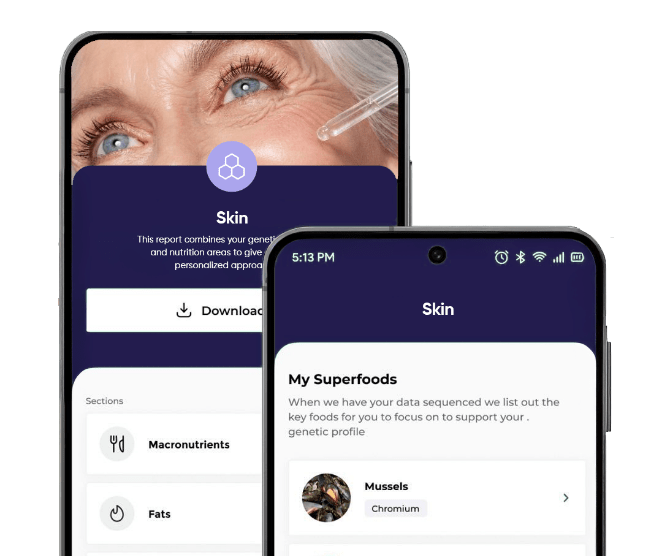
EvoDNA app screens showing skin aging, collagen support, and UV sensitivity

Personalize your skincare from the inside out

Go beyond trial-and-error with topical products. With EvoDNA skin DNA testing, you'll know your collagen genetics, personal skin care needs, and what changes your skin aging processes specifically. Then, we provide your precision health roadmap for healthier, radiant skin.

Skin DNA unlocks your glow code - care that keeps you looking great.

Expert Reviewed | Top North American Labs | Validated By YALE Innovation | Secure Data Protection

Start your journey now.

EVO EVO EVO
Live Support